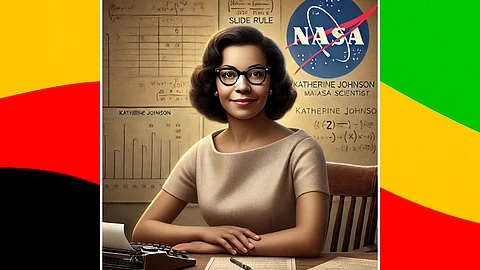


Long before computers could calculate the path of a spacecraft in seconds, NASA relied on people whose mathematical precision could mean the difference between success and catastrophe. One of the most extraordinary among them was Katherine Johnson.
A gifted mathematician from West Virginia, Johnson joined the National Advisory Committee for Aeronautics—NASA’s predecessor—in 1953 as part of a group of Black women mathematicians working at Langley Research Center. Her ability to understand complex analytical geometry eventually moved her beyond the segregated computing pool and into some of the most consequential work of the emerging American space program.
Johnson calculated and verified flight trajectories during a period when the United States was racing to understand whether humans could safely travel beyond Earth. Her work supported early crewed missions, John Glenn’s historic 1962 orbital flight, and later Apollo-era space exploration. Yet for much of her career, the public knew very little about the woman behind those calculations.
Her story is remarkable not simply because she overcame barriers of race and gender, but because she was extraordinarily good at the work itself. Katherine Johnson did not merely gain entry into rooms where Black women had historically been excluded. Once inside, her mathematical ability helped NASA solve problems it had never faced before.
Katherine Coleman was born in White Sulphur Springs, West Virginia, in 1918 and displayed an unusual aptitude for mathematics almost immediately. Because the local public schools available to Black children did not continue beyond eighth grade, her family moved during the school year so that their children could continue their education.
Johnson advanced quickly, entering high school at only ten years old and later attending West Virginia State College. There she studied mathematics under professors who recognized her exceptional ability, graduating with highest honors at eighteen with degrees in mathematics and French.
That early story deserves a little more context because it illustrates something important about her trajectory: Johnson’s brilliance was evident long before NASA existed. The opportunity eventually met an ability she had been developing for years.
In 1953, Johnson joined the National Advisory Committee for Aeronautics at Langley Research Center as a research mathematician. Like other Black women hired as “human computers,” she initially worked in the segregated West Area Computing unit, where women performed complex mathematical calculations by hand.
Her skill soon led to assignments with flight research teams dominated by white male engineers. Johnson later described asking questions, attending meetings, and pushing beyond assumptions about what work women—and particularly Black women—were expected to perform.
This is where I would strengthen the existing article. She was not simply “noticed by supervisors.” Her career reflects both extraordinary mathematical ability and a willingness to enter professional spaces that had not been designed with women like her in mind.
One of the best-known moments in Johnson’s career came during preparations for astronaut John Glenn’s 1962 Friendship 7 mission, the first American orbital flight around Earth.
NASA had begun relying increasingly on electronic computers, but Glenn wanted additional assurance that the machine-generated orbital calculations were correct. He asked Johnson to verify the numbers manually before the flight.
That moment has become famous because it captures the level of trust Johnson had earned. At a time when computer technology itself was still relatively new, one of NASA’s most visible astronauts wanted the mathematician whose judgment he trusted to check the machine.
The mission succeeded, and Glenn became the first American to orbit Earth.
Johnson’s contributions extended well beyond a single mission. She worked on trajectory analysis for Project Mercury and contributed to calculations used during the Apollo program, including work connected to the Apollo 11 mission that carried humans to the Moon.
The current article also references Apollo 13. I would phrase that contribution carefully rather than suggesting she personally calculated the entire emergency return. Better wording would be:
Johnson’s mathematical work also contributed to NASA’s understanding of backup navigation and return trajectories, knowledge that became especially important during the Apollo era when mission planners needed contingency options for getting astronauts safely home.
That is more precise and avoids overstating a specific role.
For decades, the contributions of Johnson and other Black women mathematicians at NASA were largely unknown outside the agency and their own communities. That changed dramatically after Margot Lee Shetterly’s book Hidden Figures and the 2016 film adaptation introduced millions of people to Johnson, Dorothy Vaughan, Mary Jackson, and the broader history of Black women at NASA.
This section should explicitly mention Vaughan and Jackson because it gives readers a larger historical framework rather than presenting Johnson as though she worked entirely alone.
Her story becomes even more powerful when readers understand that she was part of a community of extraordinarily talented women whose contributions had been systematically overlooked in popular accounts of the Space Race.
Katherine Johnson lived long enough to see the significance of her work publicly recognized.
In 2015, President Barack Obama awarded her the Presidential Medal of Freedom, one of the nation’s highest civilian honors. NASA later named facilities in her honor, ensuring that future generations entering the agency would encounter her name as part of its institutional history.
But perhaps the greater recognition came through the millions of young people who encountered her story and suddenly saw a different image of who could be a mathematician, engineer, scientist, or architect of humanity’s exploration of space.
There is something useful to reconsider about the phrase Hidden Figure itself.
Katherine Johnson may have been hidden from the broader public, but she was not invisible to the people whose missions depended upon her calculations. NASA engineers knew her work. Astronauts trusted her judgment. Her colleagues understood the precision she brought to problems for which there were no previous answers.
What was missing was not achievement.
It was recognition.
That distinction matters because histories of overlooked people sometimes unintentionally frame them primarily through the barriers they endured. Johnson certainly faced segregation and discrimination, but her life cannot be reduced to what others tried to prevent her from doing.
She was a brilliant mathematician.
That came first.
Katherine Johnson’s story is often presented as one of perseverance, and certainly it is. But perseverance alone does not explain her impact. Her life also demonstrates what becomes possible when talent is cultivated, education is valued, curiosity remains active, and a person refuses to accept someone else’s assumptions about the boundaries of their potential.
Her calculations helped human beings travel farther than they had ever traveled before. Yet perhaps one of her most enduring contributions happened much closer to Earth: she expanded the imagination of who could belong in mathematics, science, technology, and exploration.
Generations of young people can now encounter Katherine Johnson not as an exception hidden in the margins of history, but as one of the people who helped make that history possible.
Some lives change what humanity believes is possible by standing at the microphone. Others do it at a chalkboard, inside a laboratory, behind a desk, or through calculations most of the world will never see.
Katherine Johnson’s life reminds us that impact does not depend upon visibility. The world may not always recognize the work while it is happening, but meaningful contribution has its own gravity.
She trusted her ability, continued learning, entered rooms where few people looked like her, and kept solving the problem in front of her.
Eventually, the world learned her name.
But the work had already reached the stars.
