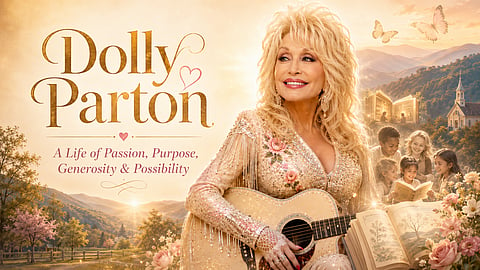


Dolly Parton’s life was never defined by music alone. Her songs made her famous, but her generosity, imagination, business instincts, commitment to literacy, and deep connection to the people and places that shaped her made her legacy much larger than entertainment.
At Soulivity, we often return to the relationship between passion, purpose, and the way a person chooses to live. Dolly’s story brings all three together. She followed what lit her up, turned her success into service, stayed rooted in who she was, and used her influence to create possibility for others.
This tribute looks at her life through that lens—not simply as a catalog of achievements, but as an example of what can happen when talent, authenticity, compassion, and purpose are allowed to grow together.
There are people whose accomplishments can be measured in awards, records sold, songs written, businesses created, or audiences reached. And then there are people whose lives seem to become larger than any list of achievements can contain.
Dolly Parton was one of those people.
She rose from poverty in rural East Tennessee to become one of the most recognizable artists in the world, writing songs that crossed genres and generations, building a career that moved effortlessly between country music, pop culture, film, television, business, and philanthropy. She sold more than 100 million records, wrote thousands of songs, became a member of the Country Music Hall of Fame, and created an artistic identity so distinct that there was never any question who Dolly Parton was when she entered a room.
But the measure of her life was never simply fame.
What made Dolly extraordinary was the way she repeatedly turned what she had been given—talent, opportunity, money, influence, memory, pain, humor, and imagination—into something that could create possibility for somebody else.
That is why her life speaks so naturally to the principles at the heart of Soulivity.
Dolly Parton understood passion early. Music was not merely something she became good at. It was something she recognized as part of herself.
She grew up as one of 12 children in rural Tennessee, in circumstances far removed from the extraordinary life that eventually followed. Yet even as a child, she imagined something beyond what she could see around her. She sang, wrote, performed, dreamed, and eventually moved to Nashville after high school to pursue music professionally. Her career grew through songwriting, her partnership with Porter Wagoner, solo success, crossover stardom, film, and eventually an enormous body of creative work.
What is striking in retrospect is not simply that she had ambition. It is that she retained ownership of her imagination.
She did not allow other people’s expectations about Appalachia, femininity, country music, class, intelligence, or appearance to decide the boundaries of who she could become. Her glamorous image was unmistakably hers. Her songwriting voice was hers. Her business judgment was hers. Her humor about herself belonged to her too.
That kind of self-possession is something we return to often at Soulivity. Our article on thinking more highly of yourself explores the importance of recognizing your own worth and refusing to abandon yourself when circumstances are difficult. Dolly’s life demonstrated that principle on a remarkable scale. She could laugh at the image she created without diminishing herself, and she could navigate industries that underestimated her without allowing their assumptions to become her identity.
Passion gave Dolly energy. But passion alone does not explain her life.
Purpose does.
One of the clearest examples of Dolly Parton’s purpose came from something deeply personal: her father could not read or write.
Rather than allowing that family history to remain simply a painful memory, she transformed it into action.
In 1995, she created Dolly Parton’s Imagination Library in Sevier County, Tennessee, providing free books to young children. The program was designed so that children could receive books regardless of family income. What began locally grew across the United States and eventually into Canada, the United Kingdom, Australia, and Ireland. By 2023, the program had distributed its 200 millionth book; by 2024, one in seven children under five in the United States was receiving an Imagination Library book each month.
That is purpose in one of its most powerful forms.
Something in her own story became a doorway for millions of other children.
It echoes a theme we explored in Living Life Purposefully with Kassandra Reinhardt: purpose does not always arrive as a grand declaration. Sometimes it emerges when something meaningful in our own experience becomes useful to someone else. Kassandra discovered that a personal yoga practice could become an accessible resource for people around the world. Dolly discovered that one family’s experience with illiteracy could become a global literacy movement.
Purpose, at its best, converts experience into service.
Dolly did that again and again.
One of the great lessons of Dolly Parton’s life is that identity does not have to become confinement.
Singer.
Songwriter.
Actor.
Producer.
Businesswoman.
Theme-park partner.
Author.
Philanthropist.
Literacy advocate.
She did not seem interested in choosing only one version of herself.
That willingness to discover what else might be possible is one of Soulivity’s central ideas. Discovery is not merely about finding new places or new information. It is about remaining open to dimensions of yourself that have not yet been expressed.
Dolly’s career continually expanded because she allowed herself to expand with it. She could write an intimate country song rooted in Appalachian life and later become a global pop-cultural figure. She could star in 9 to 5, build Dollywood in her home region, create business ventures, write books, and still identify songwriting as central to who she was.
There was no contradiction in any of it.
There was simply more Dolly.
Growth is sometimes mistaken for accumulation: more money, more fame, more recognition, more achievement.
Dolly Parton offers another model.
Her success increased her capacity to act.
In 1988, she established the Dollywood Foundation to support educational achievement in her home county. One early effort, the Buddy Program, offered seventh- and eighth-grade students a financial incentive to graduate. According to the Foundation, the dropout rate among those classes fell from 35 percent to 6 percent. The Foundation later created scholarships and expanded into the Imagination Library.
When wildfire devastated Sevier County in 2016, Dolly did not simply issue a statement. The Dollywood Foundation created the My People Fund, ultimately distributing more than $12 million to families whose primary homes had been destroyed. When Hurricane Helene struck parts of Tennessee and North Carolina in 2024, Dolly and her businesses contributed more than $2 million toward relief and recovery.
Her growth created capacity.
And then she used that capacity.
That is an important distinction.
Dolly Parton became global without becoming detached from the local.
That may be one of the most important things about her legacy.
Her hometown and the surrounding region never became merely the place she escaped. They remained part of the world she continued investing in.
Dollywood became one of the region’s major destinations and employers, while the Dollywood Foundation invested in local education, scholarships, health care, and disaster response. The Foundation helped raise $1 million for the Sevier County Hospital Birthing Unit in 2007, contributing to the creation of the Dolly Parton Center for Women’s Services.
That sense of connection also extended beyond geography.
She became one of the rare public figures capable of generating affection across cultural, political, regional, and generational boundaries. In a polarized era, Dolly seemed to understand that connection did not require sameness. She often avoided ideological labels while consistently behaving in ways that communicated dignity, inclusion, compassion, and respect. AP noted that her music and public life carried themes of women’s independence and equality even though she herself resisted being reduced to political labels.
That feels particularly resonant with the kind of community Soulivity is trying to cultivate: not agreement for agreement’s sake, but curiosity, dignity, connection, and room for people to remain themselves.
Our piece Creating Calm & Connection in a World of Chaos explores how meaningful connection often begins with something remarkably simple—seeing the person in front of us. Dolly’s public presence often communicated that same quality. The larger she became, the more people seemed to feel that she remained somehow accessible.
Perhaps the most Soulivity-like aspect of Dolly Parton’s life was this: her values did not remain abstract.
She acted on them.
When COVID-19 emerged, she donated $1 million to Vanderbilt University Medical Center to support research that contributed to the Moderna vaccine effort. Two years later, she gave another $1 million for pediatric infectious-disease research. Vanderbilt also credits her with extensive support for children’s health and pediatric cancer programs.
She supported literacy because she believed children deserved opportunity.
She supported disaster victims because her neighbors needed help.
She supported medicine because people were suffering.
She built businesses that created jobs.
She used music to bring people joy.
None of those things required her to stop being Dolly Parton.
That may be the most important part.
Purpose did not require her to become solemn. Generosity did not require her to abandon glamour. Serious impact did not require her to stop being funny. Business success did not erase compassion. Ambition did not require disconnection from community.
She integrated them.
At Soulivity, we recently revisited the idea of how to be a force for good. The premise is simple: meaningful impact is often created through intentional choices made consistently over time.
Dolly Parton embodied that principle extraordinarily well.
Her philanthropy did not consist of one dramatic act. It became a pattern.
Education.
Books.
Scholarships.
Health care.
Disaster relief.
Children.
Community.
Opportunity.
And importantly, she often found ways to build systems rather than simply perform gestures. The Imagination Library is perhaps the clearest example. A charitable impulse became infrastructure. Local generosity became an international distribution network that continues placing books into the homes of children every month.
That is what happens when compassion meets imagination.
There is another aspect of Dolly’s life that should not be overlooked.
She appeared to like being herself.
Not arrogantly.
Joyfully.
That is rarer than it sounds.
Her appearance was famously exaggerated, but it was also an act of self-definition. She knew what she liked. She knew what amused her. She understood that other people might judge it, and she largely continued anyway.
That kind of self-acceptance connects naturally to our conversations at Soulivity around self-worth and self-love. In our interview with Janet Chui, we explored how difficult it can be to love ourselves when we have learned that parts of who we are are unacceptable. Chui describes self-love as a process of unlearning those conditions and making room for the whole person.
Dolly Parton seemed to demonstrate something similar publicly for decades:
You can evolve without abandoning yourself.
You can grow without becoming unrecognizable to your own spirit.
You can be taken seriously without becoming someone else’s idea of serious.
When Dolly Parton died at 80, tributes came from around the world. Musicians, actors, political leaders, fans, and cultural institutions remembered not only the artist but the generosity, humor, humanity, and warmth associated with her. The response itself said something about the unusual place she occupied in public life.
But perhaps the most fitting measurement of Dolly’s life cannot be found in tribute statements.
It is found in a child opening a book that arrived in the mail.
A student receiving a scholarship.
A family rebuilding after a wildfire.
A patient benefiting from medical research.
A worker earning a living in East Tennessee.
A songwriter deciding to protect her own work.
A woman deciding she does not have to diminish herself to be respected.
A person somewhere hearing a song and recognizing part of their own life inside it.
Those things continue.
And that is what legacy actually is.
Passion can awaken something within us.
Purpose can give that passion direction.
But living is where those things become visible.
Dolly Parton’s life reminds us that becoming fully ourselves does not have to end with ourselves. The greater expression of a life may be what becomes possible for other people because we lived it.
She discovered who she was.
She continued to grow.
She remained connected.
And she lived her values in ways that changed the lives of people she would never meet.
Her own foundation eventually distilled its philosophy into four simple invitations for children:
Dream More. Learn More. Care More. Be More.
There is something beautifully compatible between that philosophy and ours.
Discover. Grow. Connect. Live.
Different words.
Much the same invitation.
A life does not become meaningful merely because it becomes successful.
It becomes meaningful when what was alive within us becomes something we were willing to share.
Dolly Parton shared hers with the world.
And millions of lives became larger because she did.
